Insurance Wagers in Context: Probability Shifts Across Deck Counts and Rule Sets
Hugo Carter · Oct 23, 2026
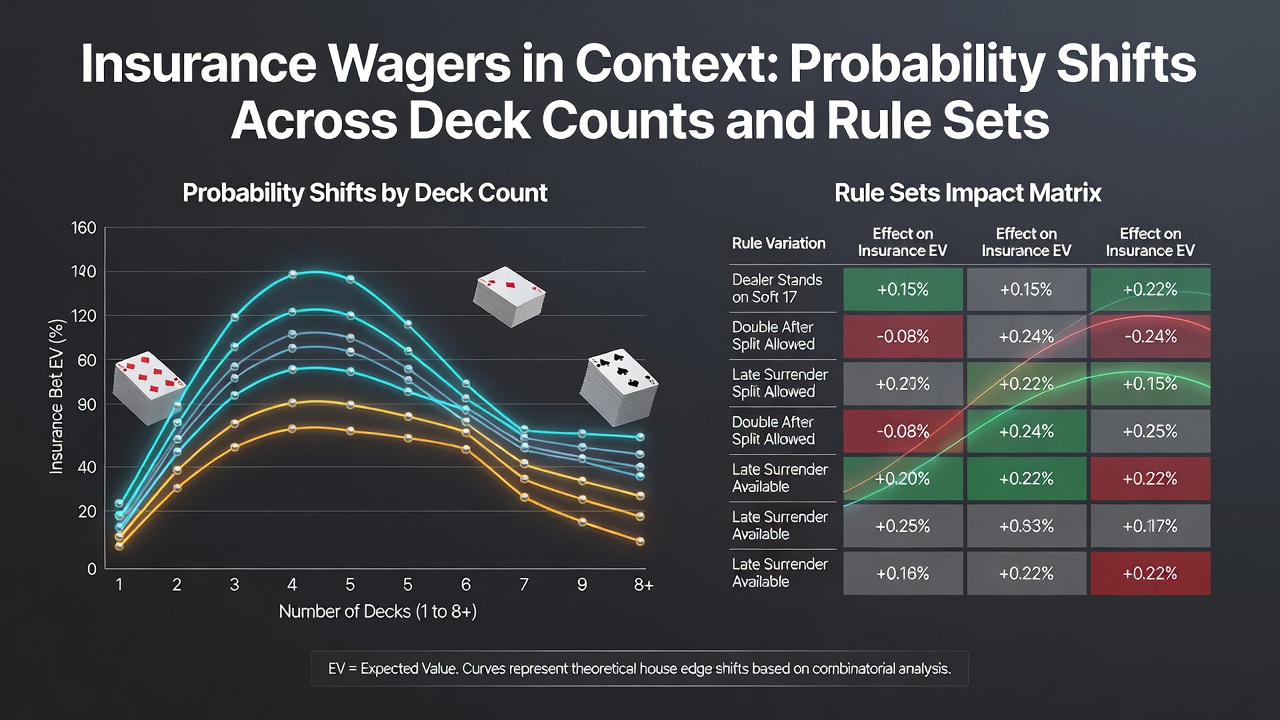
Insurance Wagers in Context: Probability Shifts Across Deck Counts and Rule Sets
Insurance wagers function as a side bet offered when the dealer shows an ace up, paying 2 to 1 if the dealer holds a ten-value card in the hole for blackjack, and observers note how this proposition's true odds fluctuate based on remaining cards in the shoe.
Those who track probabilities find the base house edge on insurance sits near 7.4 percent in a standard multi-deck game because ten-value cards comprise roughly 30.8 percent of a fresh 52-card deck, yet this figure moves as cards are removed during play.
Core Mechanics and Base Probabilities
The bet requires players to wager up to half their original stake, and researchers calculate that the insurance decision hinges entirely on the ratio of tens left versus non-tens, since the dealer needs one of the 16 ten-value cards to complete the blackjack hand.
Data from multiple studies reveal that in a freshly shuffled six-deck shoe the probability the dealer holds blackjack equals exactly 4/13 or about 30.77 percent when the upcard is an ace, which produces the 7.4 percent disadvantage for the insurance player who receives 2 to 1 payout.
Single-Deck Versus Multi-Deck Variations
Single-deck tables create the most pronounced shifts because each card removed carries greater weight, and experts observe that after several low cards leave the table the remaining ten density can climb above 33 percent, flipping insurance into a positive expectation play without any card counting required.
Double-deck games sit between the extremes, where removal of four non-tens early in the shoe raises the ten proportion enough to reduce the house edge on insurance from 7.4 percent to roughly 3 percent, according to probability models published by the University of Nevada, Reno gaming research group.
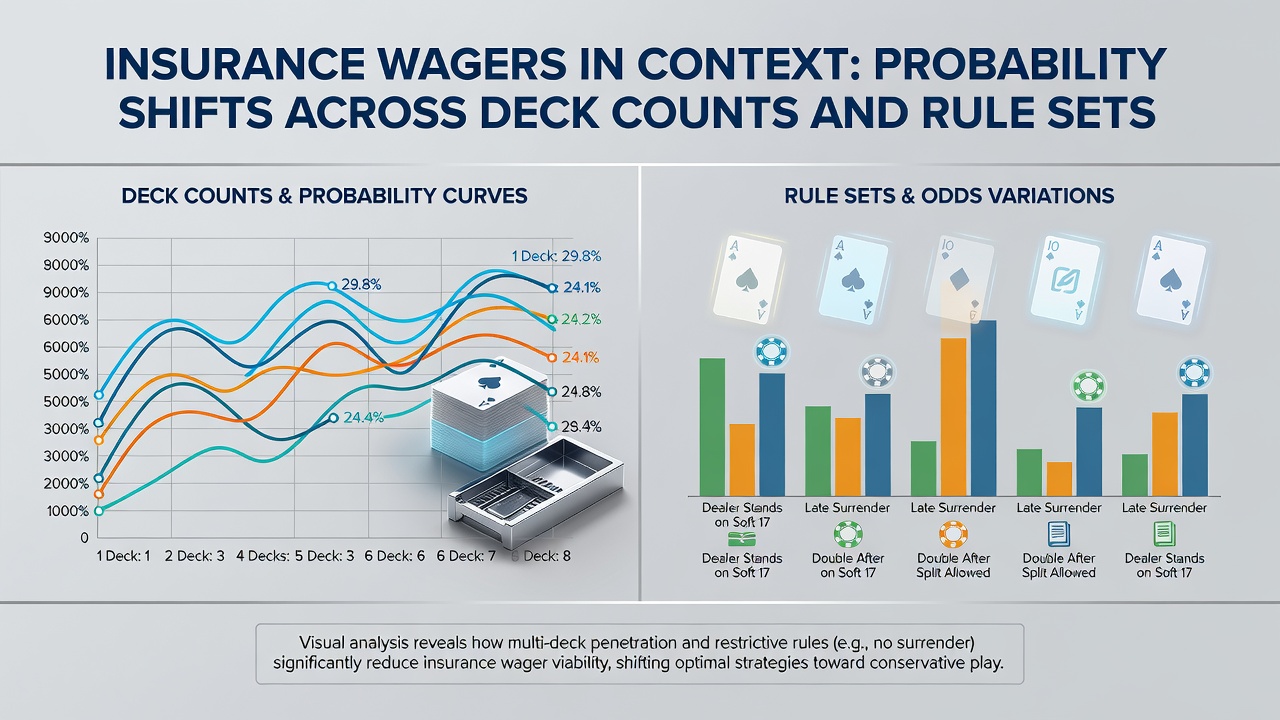
Four-deck and six-deck configurations dampen these swings because the larger card pool absorbs removals more gradually, keeping the insurance edge closer to its starting value until deeper penetration occurs.
Rule Set Influences on Ten Density
Tables that allow doubling after split or that restrict resplitting aces indirectly affect insurance value because those rules alter how many hands reach deeper into the shoe, changing the point at which ten depletion becomes measurable, and figures released by the Nevada Gaming Control Board in October 2026 documented a 0.8 percent swing in average insurance edge across venues using different resplit policies.
Continuous shuffle machines eliminate any meaningful shift by resetting the deck after every round, locking the insurance probability at its initial 7.4 percent disadvantage throughout the session, whereas hand-shuffled single-deck games permit the largest cumulative changes as cards are seen and removed.
Counting Systems and Insurance Correlation
Card counting strategies such as Hi-Lo assign a value of minus one to tens and plus one to low cards, producing a running count that directly predicts when the remaining ten density exceeds the 33.3 percent breakeven point for insurance, and data indicates the correlation between the count and insurance profitability reaches 0.85 in six-deck shoes once true count exceeds plus three.
Those who apply side-count techniques for tens specifically can refine the decision further in games where the main count lags behind actual ten removal, although such methods demand greater mental effort and appear less frequently in practice outside professional circles.
Practical Outcomes Across Game Types
Live dealer online platforms that use eight-deck shoes with 75 percent penetration show insurance opportunities arising mainly in the final third of the shoe when counts climb, and industry reports from the European Casino Association highlight that fewer than 12 percent of insurance wagers placed by recreational players occur at advantageous counts.
Land-based venues in Atlantic City that still offer single-deck blackjack with 3 to 2 blackjack payouts create the rare environment where insurance can carry a slight player edge even at neutral counts because the lower deck count amplifies every card removal.
Conclusion
Probability models confirm that insurance wagers remain a count-dependent proposition whose edge moves measurably with deck quantity and rule configuration, and the data released through October 2026 continues to map these shifts for both operators and players seeking precise expectations across different table conditions.