Card Depletion Dynamics: How Earlier Draws Alter Odds in Blackjack Games Featuring Multiple Players
Hugo Carter · Oct 9, 2026

Card Depletion Dynamics: How Earlier Draws Alter Odds in Blackjack Games Featuring Multiple Players
Card removal in blackjack creates measurable shifts in the remaining deck's composition, and these changes compound when several players participate in the same shoe sequence. Researchers track how each dealt card alters the probabilities for subsequent hands because the game uses a finite set of cards that players and the dealer draw from collectively. Data from controlled simulations show that the depletion rate accelerates with more participants, which in turn modifies the likelihood of specific outcomes like blackjacks, busts, and dealer upcard matches.
Mechanics of Deck Composition Changes
Every card removed from the shoe reduces the total count of remaining ranks and suits, which directly recalibrates the odds for the next round. For instance, the removal of a ten-value card lowers the chance that the dealer will reach a strong total when holding certain upcards, while the simultaneous removal of low cards can increase the relative frequency of high-card draws later. Studies conducted on multi-deck shoes indicate that these adjustments become statistically significant after approximately 20 to 30 cards have been played, with the effect scaling upward as player count rises from one to six or seven.
Observers note that the position of each player at the table influences which cards exit the shoe first, since order determines the sequence of draws. A player acting early might remove a critical ace or face card that would otherwise have reached a later participant, thereby reshaping the distribution for everyone downstream in that round and beyond. This positional dependency appears consistently across both live casino floors and online simulations that replicate shared shoe mechanics.
Impact of Multiple Participants on Subsequent Probabilities
With additional players at the table, the shoe depletes faster per round, compressing the window during which any single composition persists. Figures from probability models reveal that a six-player game can exhaust a six-deck shoe at roughly 1.8 times the rate of a solo session, leading to more frequent transitions between favorable and unfavorable card mixes. Consequently, the probability of drawing a natural blackjack drops from its initial 4.83 percent baseline once multiple aces and ten-value cards have been removed, yet it can rebound if low cards exit disproportionately in early rounds.
But here's the thing: the dealer also draws from the same depleted pool, so player actions that clear high cards can simultaneously weaken dealer hands in later rounds. Research indicates that when three or more players remove tens and aces early, the dealer's bust rate on stiff upcards rises by measurable margins in the following hands. These patterns hold across standard rulesets that prohibit mid-shoe entry or allow it, because the core variable remains the cumulative removal count rather than seating changes alone.
Quantified Effects Across Hand Sequences
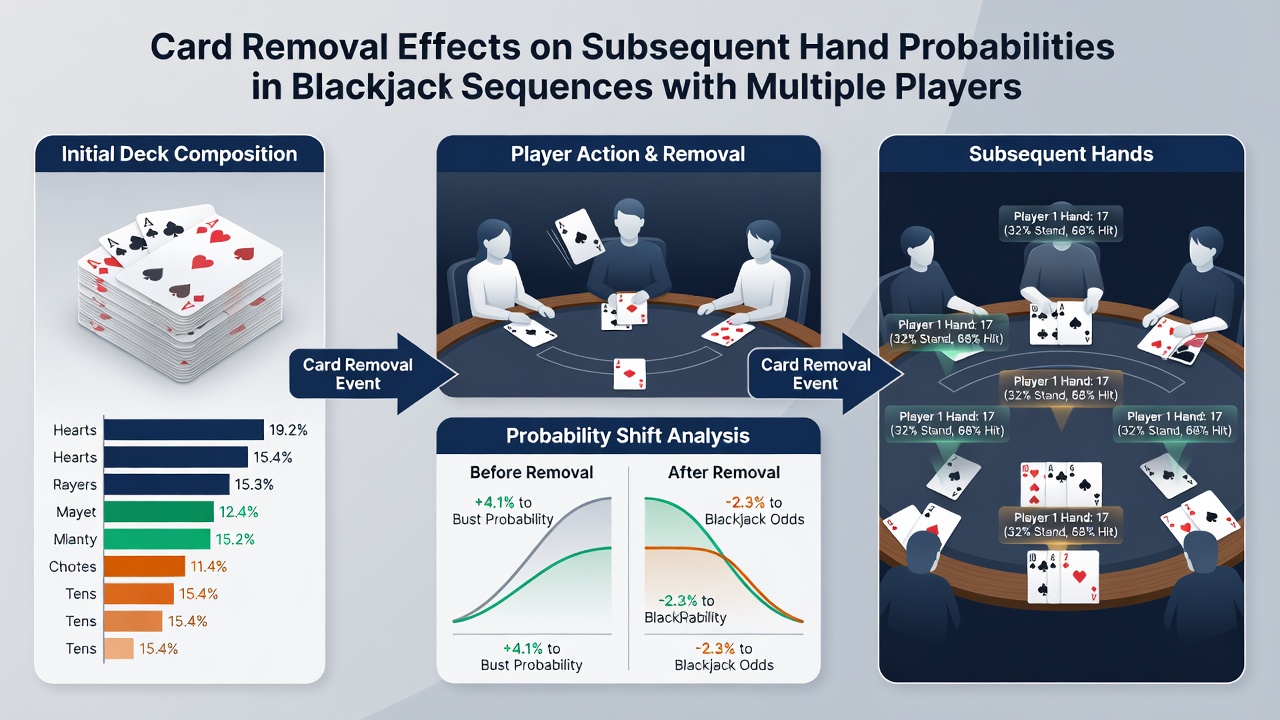
Simulation data compiled by analysts at the Nevada Gaming Control Board demonstrate that after 52 cards have been removed from an eight-deck shoe, the probability of the dealer making a hand of 17 or higher shifts by up to 1.2 percentage points depending on the ranks depleted. When multiple players contribute to that removal, the variance in those shifts widens because clustered draws of like ranks occur more often. For example, three consecutive players each hitting a pair of sevens accelerates the depletion of mid-range cards, which raises the conditional probability of later players receiving either very low or very high totals.
Turn out these effects compound across consecutive rounds rather than resetting after each hand. A sequence in which the first three rounds remove four aces and twelve tens produces a remaining deck enriched in small cards, elevating the chance that later players will bust when drawing to totals of 12 through 16. Conversely, rounds that clear low cards first tilt probabilities toward stronger player totals in the subsequent hands, provided the shoe has not yet been reshuffled.
Comparative Analysis in Shared Shoe Environments
Comparative models developed at academic centers such as the University of Nevada, Las Vegas examine how player count modulates these probability curves. Their work shows that four-player tables generate more rapid transitions between positive and negative expectation segments within a single shoe than two-player tables, because the absolute number of cards removed per round increases without a proportional increase in reshuffle frequency. This acceleration means that strategies relying on tracking specific card types must account for the compressed timeline imposed by additional participants.
What's interesting is that the effect remains consistent whether the game uses continuous shuffling machines or manual shoe procedures, since both systems still remove cards permanently until the cut card triggers a reshuffle. The difference lies only in how quickly the next shoe begins, not in the mathematical impact of each individual removal on the current sequence.
Conclusion
Card removal effects propagate through blackjack sequences in predictable ways that scale with the number of players sharing a shoe. Probability adjustments arise directly from the ranks and suits that exit the deck, and multi-player environments accelerate those adjustments by increasing cards dealt per round. Data collected from regulatory simulations and university research confirm that later hands carry altered odds based on earlier depletions, creating a chain of dependent outcomes that persists until the shoe resets. These mechanics operate uniformly across standard rule variations and table sizes, providing a stable foundation for understanding how finite deck resources influence hand results over time.